Results
- 25Mstudents reached by BrainPOP content I worked on
- 42%higher student test scores after I redesigned college writing curriculum
- 39%teacher engagement with the BrainPOP Science launch, up from 3%
- 94%prompt quality on the AI features I own, up from 90%, with zero launch blockers
- 8.5xestimated savings on AI tooling costs
- 20%fewer content errors after I set review standards across four products
What I bring to a learning team
K–12 curriculum and teaching
Fifteen years as a K–8 teacher and principal and a 7–12 English teacher. I’ve written curriculum by hand, reviewed ELA curriculum for standards alignment, and taught online and hybrid courses.
See howHands-on AI production
I write and test the prompts behind AI features at Thumbtack, run evals with AI judges, and build the Claude skills and plugins teams use every day.
See howQuality I can defend
I review AI output against clear criteria, and I say no when it isn’t good enough, even close to a launch date.
See howLeading people through change
I’ve led schools through reorganizations, built and managed teams of educators and tutors, and now train designers to work with AI.
See howHow I run AI content production
AI can draft a lesson in seconds. The hard part is knowing it’s right for the student in front of it. So every prompt I own goes through the same seven stages, and each one ends with a review checkpoint before it moves on.
-
Strategy
Define the goal, the use case, the model, the limits, and what success looks like.
Checkpoint: Stakeholders sign off on scope before anyone writes.
In a learning team: Learning goals, audience, and scope come first, like a scope and sequence.
-
Crit
The team critiques the draft for clarity, tone, edge cases, and fit with what the product needs.
Checkpoint: Feedback is captured and prioritized.
In a learning team: Peer review of a draft lesson.
-
Swarming
We work on the prompt together, in real time, using the crit feedback.
Checkpoint: Every change is written down.
In a learning team: Co-planning, with everyone editing together.
-
Bug bash
Anyone can try to break it. We look for odd outputs, edge cases, and failure modes.
Checkpoint: Bugs are sorted by how much harm they could cause.
In a learning team: A pilot where you try to break the lesson before students do.
-
Testing
We run the prompt against written test cases before a wider rollout.
Checkpoint: Results are documented and signed off.
In a learning team: Checking the output against an answer key.
-
Evals
We score the prompt against quality metrics, with automated runs and human review.
Checkpoint: No sign-off, no launch.
In a learning team: Scoring with a rubric and more than one grader, the way teams norm their scoring.
-
Post-launch review
We watch real outputs and their effect on people after launch.
Checkpoint: Lessons go into the next version.
In a learning team: Looking at real student work, then revising.
Briefs, records, and escalation
- A brief before any prompt. Every prompt starts with a written brief: the goal, the audience, the model, the limits, and what success looks like. For a lesson, that means the learning objectives, the grade level, and the standards it has to meet.
- A clear path when AI gets it wrong. Small issues get fixed in review. Errors that could mislead or harm someone stop the work and go to the person who can make the call, like Legal for a privacy risk.
- A record of every version. I keep a changelog for each prompt and a handoff doc, so anyone can pick up the work and see why each change was made.
- Choosing the right tools. I run research audits that compare AI tools side by side. At Thumbtack, I test and build with the leading AI tools to help decide where and how our builds and agents should live. Those audits also help us decide when to build our own tools and when to use what’s already out there.
I built a Claude skill that sets up every new prompt with the same stages and tasks, so nobody skips a checkpoint.
An agent workflow I run every week
Our content design office hours run on an AI agent workflow I built, with a person approving each step that matters:
- Before: The morning of a session, an agent sends me who’s coming and what they need, and reminds them for me.
- After: It sums up what we discussed, flags new terms for our terminology repository, and drafts a follow-up.
- Quality gate: I review and approve every follow-up before it’s sent.
- Tracking: Every session is logged, so we can spot patterns in what teams need.
The same pattern works for curriculum: agents draft and organize, and a person approves at a quality gate before anything reaches editorial review.
Quality, standards, and risk
I don’t trust a prompt because one output looked good. I test it the way I used to check student writing: against clear criteria, with more than one reader.
- LLM judges. I score each prompt version against a set of test cases, with several independent AI judges per case, and compare the scores and notes across versions.
- Quality and hallucination criteria. The judges check whether the output is accurate, complete, and clear, and whether it adds anything that wasn’t there.
- A harm-based error framework. Not every mistake is equal. An awkward sentence is a small problem. A wrong fact in a science lesson, or a reading passage above a student’s level, is a big one. I sort errors by the harm they could cause, and the biggest ones block a launch.
- People stay in charge. When AI refined prompts on its own, it drifted from what the product needed. Every change goes through human review.
Using data to improve
I look at what the results say, then revise. In college writing, test scores rose 42% after I redesigned the curriculum and exams. In K–8, an achievement-gap program I led beat test benchmarks by 15%. With AI, every launch ends with a review of real outputs and feedback, and what we learn goes into the next version.
What I check in AI-made lessons
- Does it teach? The lesson has to teach what it set out to teach, at the right level and in the right order. I review curriculum through an educator’s eyes as well as a content designer’s.
- Standards alignment. At ECS Learning Systems, I reviewed ELA curriculum for major publishers, checking it against standards.
- Accessibility. With UX of EdTech, I ran design audits that brought edtech products to full WCAG accessibility compliance.
- Bias and inclusivity. My ECS reviews also checked curriculum for inclusivity, so every student can see themselves in it.
- Accuracy and originality. My evals flag anything the AI adds that wasn’t in the source. In curriculum, that’s where made-up citations and uncredited material show up, so they get the same check.
- Copyright and rights clearance. I make sure every passage, image, and quote in a lesson has the right credit. I catch copied or uncredited material in drafts from writers, vendors, or AI, and send it back or replace it. I work with legal and permissions teams to clear material before it’s published, and I’ve handled rights for the books and articles my Writer’s Grit clients published, plus my own BrainPOP blog and Medium articles.
Protecting people’s information
The day before AI call summaries launched at Thumbtack, we were still testing, and a bug bash showed the AI repeating sensitive personal details from a few test calls. The plan was to keep refining the prompt after launch. I made the case to pause instead, brought Legal clear examples, and worked with engineering to remove sensitive details before the AI ever sees them. The final tests came back clean, and the feature launched to all users a few days later. It’s the same instinct I bring to student data.
Good judgment works the other way too. When a newer prompt didn’t clearly beat the old one in evals, I didn’t ship it.
Read the public summary of AI call summaries →
Leading teams through change
I’ve been on both sides of this shift. I started as the writer, then managed writers and educators, and now I teach teams to direct AI instead of drafting every word by hand.
- Reorganizing schools. As a principal, I led schools through reorganizations that set up new teams, new structures, and new learning standards and processes, with a staff of 14 and more than 40 volunteers.
- Building teams of educators. At BrainPOP, I hired, trained, and managed a team of five learning coaches. At Writer’s Grit, I grew a team of more than 10 remote tutors and writing specialists and trained each one.
- Training the trainers. OpenAI trained me as a trainer for Thumbtack’s AI Champions. Now I train content designers every week during AI Build Time.
- Onboarding new designers. I’m the go-to onboarding guide for new content designers, and I run content design intros for product designers joining the team. Each one leaves with our style guide, writing tools, and a place to ask questions.
- AI Build Time. I host a design-organization-wide build time where designers try AI tools on real work, together.
- AI Champions. I’m the design representative on Thumbtack’s AI Champions team, leading new AI initiatives for the design organization.
- Content design office hours. I turned office hours into ongoing research on what our internal teams need, and our AI tools keep teams organized, surveyed, and coming back. Read how we did it. In our latest feedback, satisfaction reached 95%, and every attendee said they’d come back.
- Writing-help plugins. I own our content design plugins for Figma, Claude, and ChatGPT: tools that check work against our standards, so people get feedback without waiting on a reviewer.
- Training managers. At BrainPOP, I trained managers on how to work with content design teams. At other edtech companies, I’ve trained managers on how to build content strategies.
Curriculum and classrooms
I spent 15 years in K–12 and college classrooms and school leadership before I moved into edtech. My first teaching job was college writing at La Sierra University. Then I spent eleven years as a K–8 principal at two schools, and for eight of those years I taught a class too. As a principal, I led an achievement-gap program that beat test benchmarks by 15%.
Later, I taught 7th–12th grade English and journalism at Dallas Christian Academy, where I built a dual-credit program so students could earn college credit before they graduated. I’ve also taught college essay and research writing at Dallas College and West Coast University.
Teaching online. I taught college writing remotely for West Coast University, taught hybrid courses over Zoom to students in grades 5–12, and led the curriculum design for a virtual after-school program with Boston Public Schools. I also earned an online teaching certificate from Duke University.

Curriculum and standards
As an ELA content strategist at ECS Learning Systems, I built curriculum that turned what teachers need to teach into materials students could actually use. I reviewed ELA curriculum for major publishers, checking it for standards alignment, accessibility, and inclusivity, and helped design materials and assessments.
Designing courses
Content design and course design start with the same question: what does this person need next? I’ve designed courses for elementary, middle school, high school, and college students, for homeschool families and public and private school districts.
A second lens on the curriculum
I worked alongside BrainPOP Science’s instructional design team and reviewed the curriculum through two lenses: an educator’s and a content designer’s.
Leading the learning coaches
For Grobo, a new play and learning app, I led our learning coaches, a team of five educators, in building content for kids. I also led its voice, tone, and naming.
A virtual after-school program
My Writer’s Grit tutors, a mix of teachers and PhDs, taught the classes. I led them in designing the curriculum.
Edtech tools I use
- Canva
- Google Classroom
- Pear Deck
- Plickers
- Socrative
- Gimkit
- IXL
- BrainPOP
- Kahoot!
- Quizlet
- Google Forms
- SurveyMonkey
- Typeform
- Adobe Express
- Flip
- Seesaw
- Miro
- Padlet
- Edpuzzle
- Remind
BrainPOP
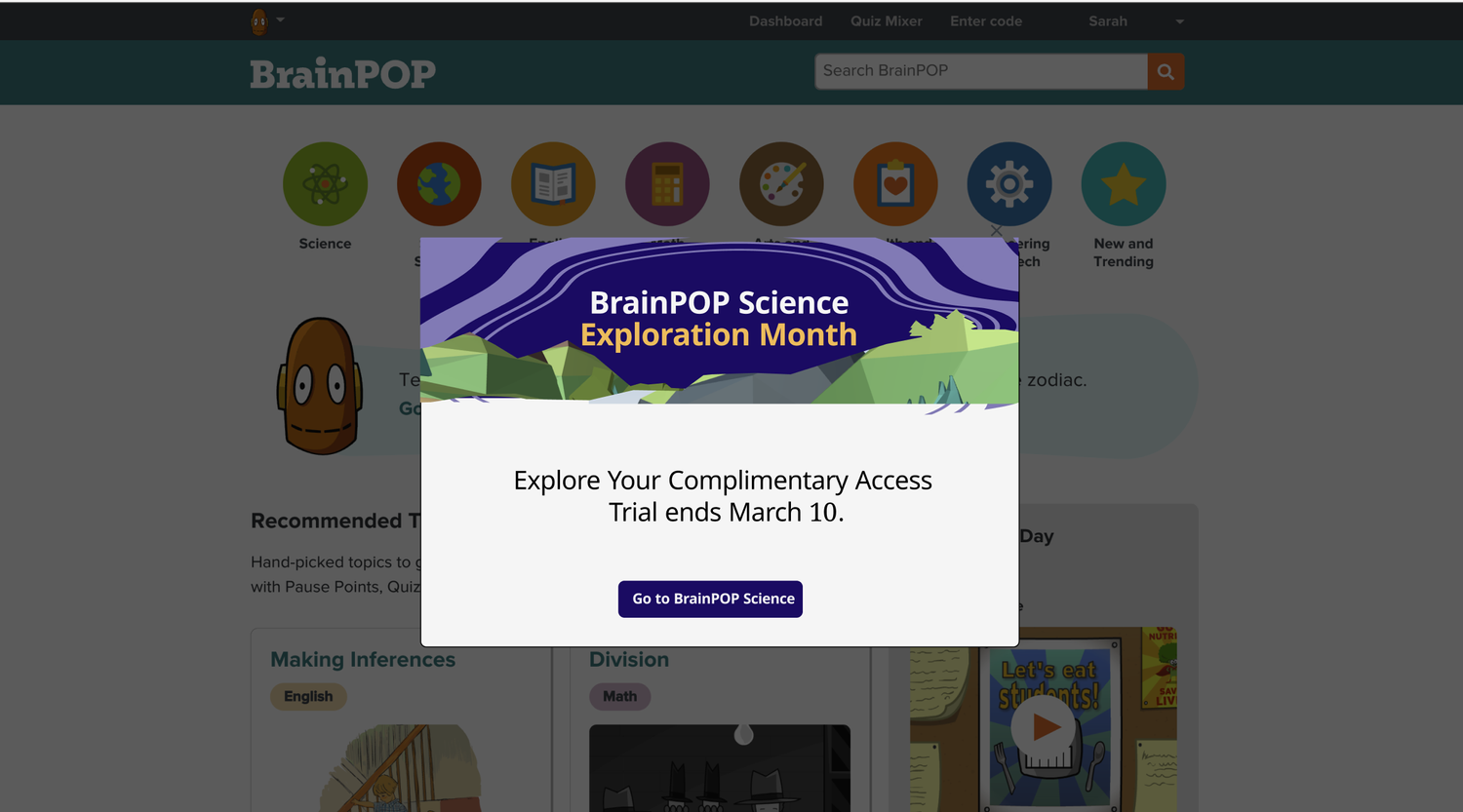
At BrainPOP, I started as a content manager, leading a team of five writers, then moved into UX writing and research. I led the research and content for an AI grader and pushed for a toggle that kept teachers in control. My free-trial messages for BrainPOP Science took engagement from 3% to 39% and brought in 570 leads when the goal was 250. On the assessment side, I migrated 90% of legacy assessment content to work better with teachers’ learning management systems and led content strategy for a new student assessment engine.
Coaching students
In 2019, I founded Writer’s Grit, a writing company. We coached young writers one-on-one and helped working writers publish books and magazine articles.
More BrainPOP case studies (password-protected):
- Designing for educators
- AI-assisted grading and onboarding
- First-time use research: onboarding students to BrainPOP Science
- Leading content design by establishing standards
- Grobo: a play and learning app
Where I’ve worked in edtech
Full time and on contract, I’ve helped edtech teams make their products easier for teachers, families, and students to use.
 Content manager to senior UX content designer and researcher · 2021–2025
Animated lessons for K–12 classrooms. I wrote launch messaging, researched in classrooms, and kept four products speaking in one voice.
Read the case study (password-protected) → Senior content designer · 2024
A field trip app for teachers, parents, and students. I wrote the sign-up and trip-planning content so one flow worked for all three.
Read the case study (password-protected) → Senior content designer and UX researcher · 2024
Wayground, formerly Quizizz, is a learning platform teachers use for quizzes, lessons, and practice.
Visit Wayground → Senior content designer · 2026
LitLab makes curriculum-aligned decodable books and fluency practice for young readers.
Visit LitLab → Senior content designer and UX researcher · 2022–2026
I led editorial, including a three-part series on UX writing in edtech, and I co-host the UX of EdTech podcast with design leaders from Google LearnLM, Canva, IDEO’s Play Lab, and Microsoft Education.
Listen to the podcast →